What Is Jupiter?
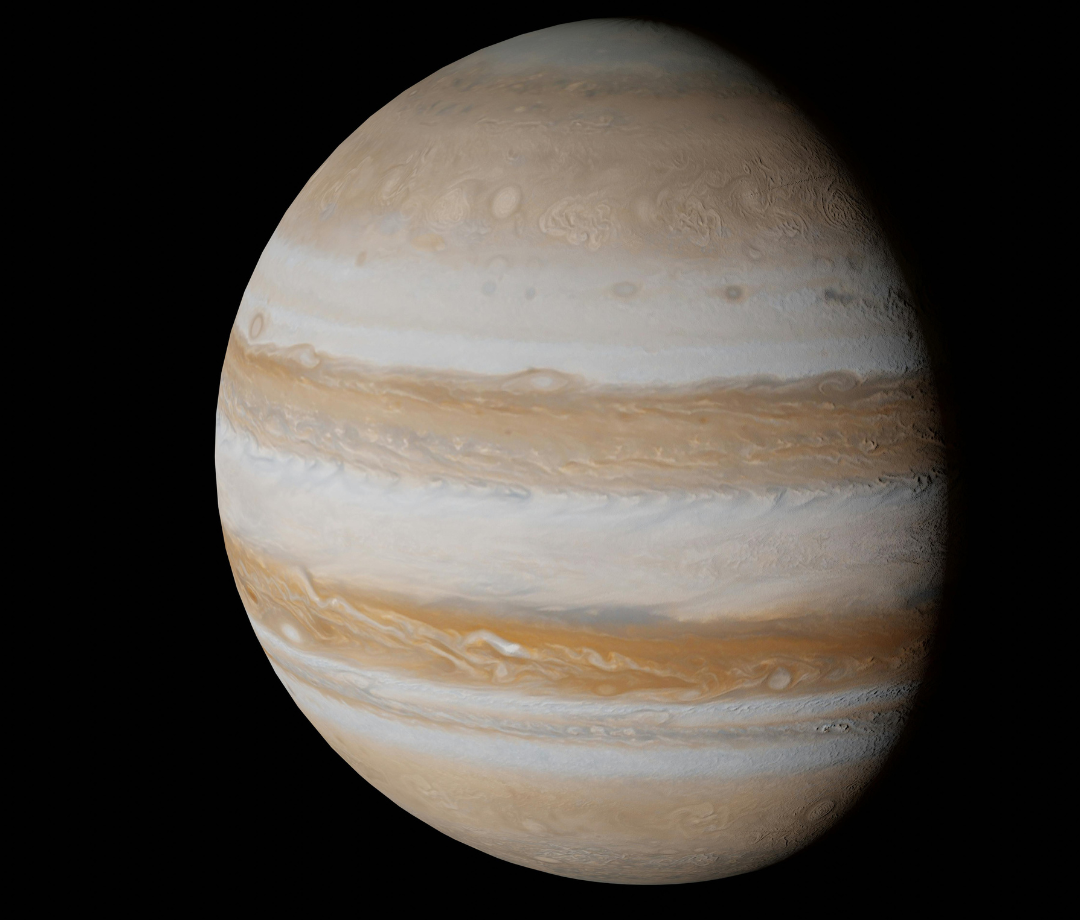
Jupiter is the fifth planet from the sun, and the first of the gas giants. It is known for its large size, great red spot, large number of moons, and proximity to the asteroid belt.
It is the largest planet in the solar system, larger than every other object in the solar system other than the sun. Its mass is over twice as much as all seven other planets in the solar system put together. It is over ten times as wide as the Earth, and over 1000 times the overall size of the Earth. However, these are reversed with the sun, which is over 10 times as wide and over 1000 times as large as Jupiter.
During its trip around the sun, it ranges from about 5 to 5.5 times as far from the sun as Earth. It is made up of about 3 quarters hydrogen and 1 quarter helium, with trace amounts of other gases present.
Jupiter has dozens of moons. The four largest, Europa, Io, Ganymede and Calisto, were discovered by Galileo in 1610, and were the first four moons discovered orbiting any planet other than Earth. They are known as the Galilean Moons and are some of the most interesting objects in the solar system.
How Long Are Days And Years On Jupiter?
Jupiter takes almost 12 years to orbit the sun. Despite its massive size, a day on Jupiter lasts less than 10 hours. Its gaseous state makes it spin much faster than a rocky planet does.
What Is The Atmosphere On Jupiter Like?
Just like the planet, Jupiter’s atmosphere contains about 3 quarters hydrogen and 1 quarter helium, with other gases. It should be noted that, like the other gas giants, Jupiter does not have a solid, consistent ‘surface’, making it different from Mercury, Venus, Earth and Mars in this respect. Scientists refer to the surface as the place where the pressure is equal to Earth’s surface pressure.
How Warm Is Jupiter?
Temperature estimations vary wildly on Jupiter. Estimates for the average temperature on the surface are estimated to be -110 C (-166 F). Going upward can cause the temperature to get even colder, with temperatures of –160°C (-256) being the norm higher up. However, at the very top of the atmosphere, over 1000 km (621 miles) above the surface, the temperature rises, hitting 1000 C (1832 F) due to the fact that hydrogen makes up an even larger portion of the makeup, with much less helium.
How Windy Is Jupiter?
Jupiter is very windy. The famous great red spot is actually a hurricane that’s larger than the Earth, where the winds reach up to 680 km/h (425 mph), which would make even a category 5 hurricane on the Saffir-Simpson scale look tame by comparison. Even the jet streams reach 360 km/h (220 mph) regularly. Even crazier are the winds at the poles, which can reach an ungodly 1450 km/h (900 mph).
How Rainy Is Jupiter?
There is helium rain on Jupiter. It comes down very regularly.
Does Jupiter Have Storms?
Yes, Jupiter is home to storms, many of which are large and powerful. Jupiter has thunderstorms that contain lightning that is several times stronger than that of Earth. It also has storms that last for a few days. The great red spot has been observed constantly since 1831, with observations of a great red spot having been seen before this, but it is unknown if it was the same storm.
Can Jupiter Support Life?
In theory, Jupiter could support microscopic extremophiles that can swim. The extreme temperatures, both hot and cold, lack of a solid surface, lack of water, and extremely high gravity are all very detrimental to life as we are familiar with it.
Can Jupiter Be Terraformed?
Most likely not. The extremely high gravity, gaseous state of the planet, distance from the sun, and wide range of temperatures make it extremely difficult to adapt for human life, even when compared to other planets. Some of its moons, such as Ganymede and Europa, might be candidates if they can be heated up.