
What Is Dihydrogen Monoxide?
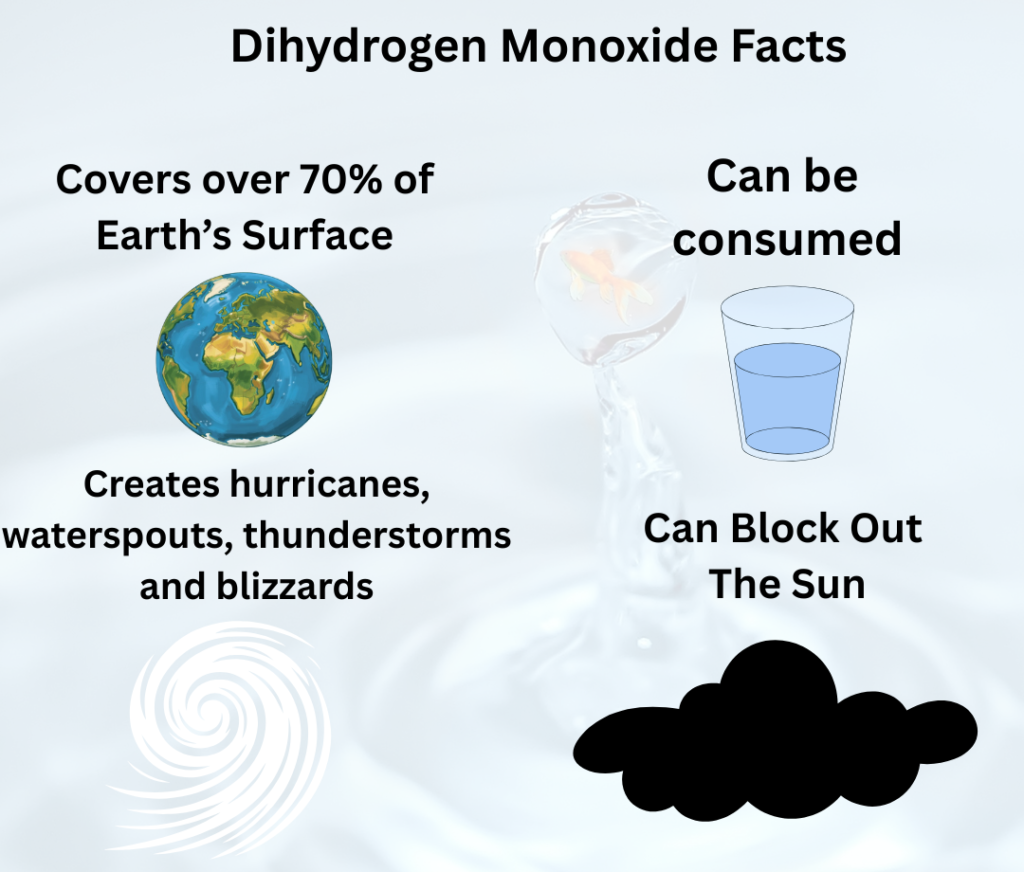
Dihydrogen Monoxide is a naturally occurring compound that is two parts hydrogen (H2) and one part oxygen (O). It can consistently be found on Earth as a solid, liquid, and gas. Its liquid form, which covers over 70% of the Earth’s surface, is one of the few that expands when frozen, which allows its solid form to float when in its liquid form. Most large concentrations of dihydrogen monoxide are filled with large amounts of salt, with much of the rest inaccessible due to being frozen.
This substance has also been found on Mars, and many moons of Jupiter, Saturn, Uranus and Neptune.
How Does Dihydrogen Monoxide Impact Weather?
There are many ways that Dihydrogen Monoxide affects the weather. These include the following:
- It often falls from the sky, which can lead to the cancellation of many outdoor activities, such as baseball games and soccer games. This can also reduce visibility when it is blown around, and lead to school days being cancelled.
- It can accumulate in large quantities on the ground in freezing conditions.
- It is instrumental to the formation of, and damage caused by, hurricanes, thunderstorms, waterspouts, blizzards, and other dangerous storms.
- It is a necessary component of acid rain.
- It can lead to the creation of fog, leading to lower visibility.
- When concentrated in high amounts within the sky, it can block out the sun, often for days at a time.
These impacts can create the following disruptions:
- High amounts of flooding, leading to billions of dollars of damage per year.
- When frozen, it can cause slippery conditions for driving and walking, leading to vehicle accidents and falls.
- Increased rates of hypothermia and frostbite.
- When found in the air, it increases humidity.
- It can damage both natural and man-made objects due to erosion and rusting.
- It can lead to the creation of quicksand.
- It can be dangerous when it interacts with electricity.
It can also disrupt society in many other ways. It is best to be cautious when interacting with dihydrogen monoxide.
What Other Impact Does Dihydrogen Monoxide Have On Our Lives?
There are plenty of other ways Dihydrogen Monoxide has impacted our lives, not related to weather.
- It can create other natural dangers, such as natural floods or tsunamis.
- When stationary, it can be dangerous for children and other vulnerable people.
- It can create an environment where dangerous animals, such as sharks, octopi, killer whales, and many others, can increase their population.
- Contributed to the sinking of numerous ships, including the infamous sinking of the Titanic.
- Makes large areas of the Earth uninhabitable for human life.
- It is found in dangerous items, like excrement and poison.
Please note that there are many more impacts than this, as these are just examples.
Is Dihydrogen Monoxide Safe To Consume?
Usually, yes, consuming dihydrogen monoxide is not only safe but useful, as it provides vital hydration and can help regulate body temperature, boost the immune system, prevent fatigue, and help increase alertness and mood. It is recommended by health experts that dihydrogen monoxide be consumed daily, either independently or as a part of other food or drink. However, there are some risks of consuming large amounts at once:
- It can increase the need to urinate when consumed quickly.
- It can cause cramps, bloating, and other issues.
- It can cause digestive problems, including vomiting.
- Many of the benefits might be reversed, for example, alertness and mood might be lowered.
It is also important to note that some forms of dihydrogen monoxide can be contaminated with dangerous products, such as lead. Please check with your local municipality if you believe this might be a concern.
Is Dihydrogen Monoxide Useful?
Yes, Dihydrogen Monoxide has several uses. They include the following:
- It is often found in beverages, and is often even consumed as a solitary beverage.
- It is very useful for hygienic practices.
- Often used to assist in the consumption of pharmaceuticals.
- Used by athletes to improve performance.
- Used to assist the growth of plant life.
- A common addition to pools.
- Used as a power source in hydroelectric plants and dams.
- Often found in taps, faucets, toilets, and other plumbing devices.
Please note that these are not the only uses for this compound. Keep your eyes out for ways that dihydrogen monoxide can be used in your life.