What Is The Koppen Climate Classification?
The Koppen Climate Classification is a system used to divide every place on land in the world into one of five categories of climate based on what an average year is like in a certain area. Each category is represented with a letter. However, each of these categories has subcategories, meaning that places will have two, and often even three letters, in their Koppen Climate Classification.
History Of The Koppen Climate Classification
The Koppen Climate classification was created by meteorologist, climatologist and botanist Wladimir Koppen in 1884. While his climatology and meteorology knowledge played a large role in determining the system, it was greatly supported by his knowledge of botany, as he noticed how different types of vegetation grew in substantially different climates. He made changes to the system in 1918 and 1936, and further changes were made by another climatologist, Rudolf Geiger in 1958 and 1961. As a result, it is sometimes called the Koppen-Geiger Climate Classification.
What Are The Categories Of The Koppen Climate Classification?
The five categories of the Koppen Climate Classification are tropical, dry, temperate, continental and polar. Here is a chart showing each of them, with their subtypes:
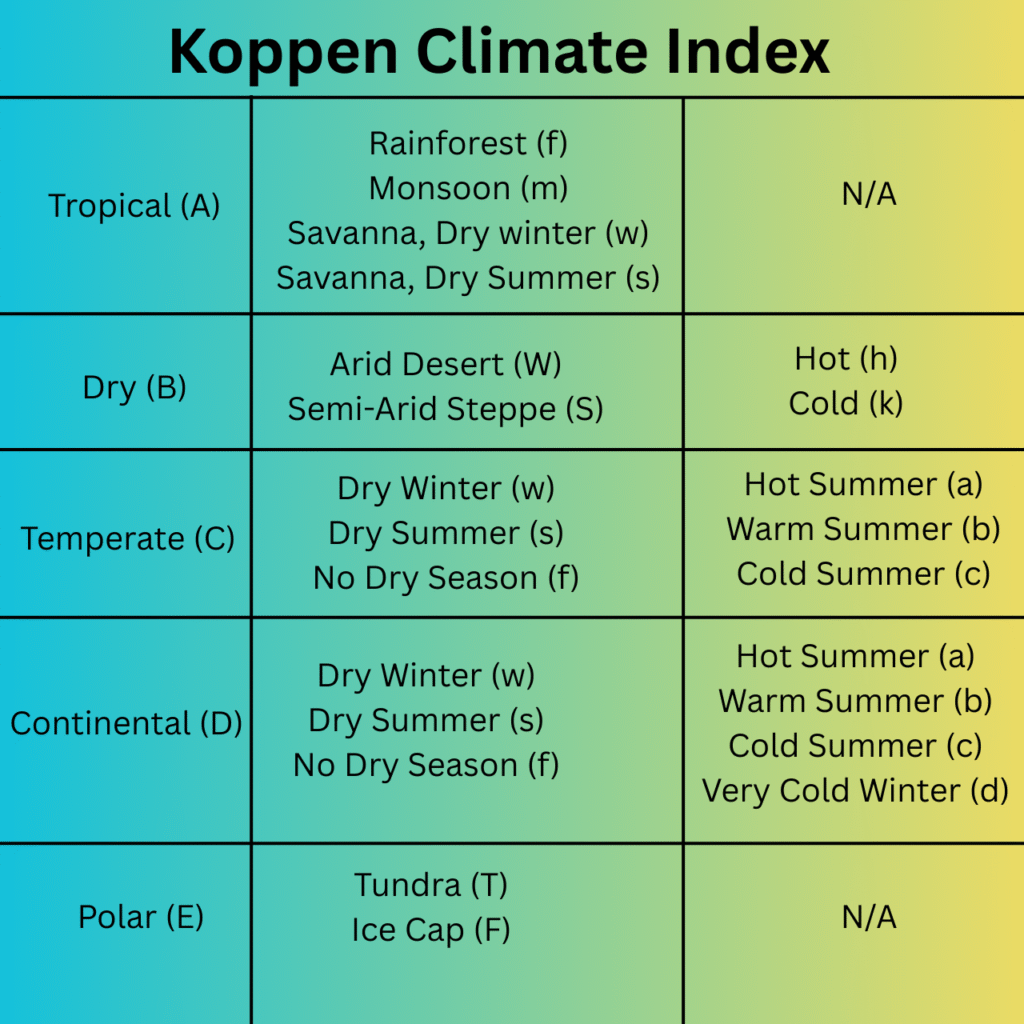
Everywhere in the world (or at least on land) falls into one of these categories. First, we would see which of the five categories a place lands on. For example, if a place has at least one month with average temperatures above 10 C (50 F), and at least one month where the average temperature is below 0 C (32 F), it would be considered continental (D). At that point, we would see if it falls under the dry winter, dry summer or no dry season category, and then under hot summer, warm summer, cold summer or very cold summer. If it has the conditions for dry summer (s) and warm summer (b), it would be graded as Dsb.
There are a few things that should be noted in this, to better understand the terminology used:
- Each of these uses annual averages, so it is possible that over a year, a city will not fall into the category given.
- For the purposes of measuring seasons, “summer” is noted as the time from April until September, with “winter” being from October – March. This is reversed in the southern hemisphere.
- Dry and wet refer to the amount of precipitation, on average, throughout the season mentioned.
- Not all of these classifications are found in Canada.
- Hot and cold refer to average temperatures, not highs or lows.
What Is A Tropical Climate?
A tropical climate (A) is the hottest of the five. It is defined anywhere that the average temperature is at least 18 C (64 F) every month of the year. There are four possible subcategories, rainforest (Af), monsoon (Am), savanna (dry winter) (Aw), and savanna (dry summer) (As). They also tend to have plenty of precipitation and are very humid, but this part is a tendency instead of a hard rule. This type of climate is often found in Central America, South America, Africa, and many South Asian Islands. They are not found in Canada.
A Tropical Rainforest (Af) climate will average at least 60mm of precipitation each month of the year.
A Tropical Monsoon (Am) climate will have at least one month where the average precipitation is below 60mm. However, even its driest month will have more than 100 – (total annual precipitation in mm/ 25). This generally means more moderate amounts of rain throughout the year.
A Tropical Savanna (As or Aw) climate will have at least one month where the precipitation totals less than 100 – (total annual precipitation in mm/ 25). This often means having a dry season and a wet season. Ones with a dry summer are labelled as (As) climates, while those with a dry winter are referred to as (Aw) climates. The length of the wet and dry seasons varies from region to region, with some places having much longer wet season, some having much longer dry seasons, and yet others having the two be about the same length on average.
What Is A Dry Climate?
A dry climate (B) is heavily defined by its lack of precipitation. Unlike a tropical climate, it has two categories. The first subcategory is represented by the second letter is one that shows how little precipitation, which is described as a desert (W), or semi-arid (S). The second subcategory shows the temperature, whether it is hot (h), or cold (k). These are represented with B, followed by the second subcategory letter, and then the third subcategory letter. For example, a hot desert would be referred to as a BWh. This type of climate is rare in Canada.
To determine if something is a dry climate, the amount of precipitation in millimetres must fall below a specific threshold. Two numbers are added up to determine this threshold, which we will call A and B.
A is calculated by taking the average temperature of the region in Celsius and multiplying it by 20. B then add either 280, 140 or 0. If over 70% of the annual precipitation is in the summer, B is 280. When less than 30% of the annual precipitation is in the summer, B is 0. If between 30% and 70% of the annual precipitation is in the summer, B is 140. Any region where the annual precipitation in millimetres, is less than A plus B, the place is rated as a dry climate. If it is less than 50% of this threshold, the region is a desert (BH). If it’s between 50% and 100%, it’s Semi-Arid (BS).
In either case, if the average temperature is 18 C (64 F) or more, it is considered hot (h). Otherwise, it is considered cold (k).
What Is A Temperate Climate?
A temperate climate (C) will generally have moderate temperatures. In these climates, the coldest month averages between 0 C (32 F) and 18 C (64 F), with the warmest month averaging at least 10 C (50 F). This one also has two subcategories, with the first subcategory (second letter) describing how precipitation is balanced throughout the year, and the second subcategory (third letter) describing how hot the summer is. This type of weather is common in mid-latitudes, especially near shorelines, and the temperature between seasons is usually quite noticeable. A few cities in Canada fall into this category, mostly southern cities on the coast.
A dry winter (Cw) is defined as a climate where the wettest summer month receives ten times as much precipitation than the driest winter month. A dry summer (Cs) has three times as much precipitation in the wettest winter month than the driest summer month. If neither of these precipitation conditions is met, it is considered not to have a dry season (Cf).
There are three grades for how warm the summer is. The first is hot summer (a), which will have at least one month when the average temperature is above 22 C (72 F). The second is warm summer (b), which will have at least four months where the average temperature is above 10 C (50 F), but no months where the average temperature is above 22 C (72 F). A cold summer (c) is one where only 1-3 months average above 10 C (72 F).
What Is A Continental Climate?
A continental climate (D) is the type of climate that is most common in Canada, being the case in most places except for the polar regions. It is often similar to a temperate climate, in the fact that it has distinct differences between the four seasons, except this is even more extreme. While it keeps the requirement of having at least one month of being at least 10 C (50 F), the coldest month averages below 0 C (32 F). It is also the type of climate that features the most extreme weather, such as thunderstorms and tornadoes.
Continental climate has the same subcategories as temperate climates- dry summer (Ds), dry winter (Dw) and no dry season (Df), except with a D as the first letter instead of C. It also shares definitions of hot summer (a), warm summer (b), and cold summer (c). However, it also has a fourth possibility for the final letter, a very cold winter (d), which has the last month as averaging below -38 C (-37 F).
What Is A Polar Climate?
A polar climate (E) is one where no month has an average temperature above 10 C (50 F). The two subtypes of this are Tundra (ET), which has at least one month where the average temperature is above freezing, and Ice Cap (EF), which is what it’s called when every month has an average temperature below freezing. This type of climate is found in the Arctic and Antarctic. In Canada, only the islands on the northern end of the territories have this climate.
What Are Certain Cities In Canada Rated On The Koppen Climate Classification?
Due to its sheer size, Canada sees a large number of climates. Here is a list of which type of climate some of the most well-known cities in Canada have.
Bsk (Dry semi-arid, cold): Lethbridge
Cfb (Temperate, no dry season, warm summer): Vancouver, Surrey
Csb (Temperate, dry summer, warm summer): Nanaimo, Victoria
Dfa (continental, no dry season, hot summer): Toronto, Mississauga, Brampton, Hamilton, Windsor, Niagara Falls
Dfb (continental, no dry season, warm summer): Montreal, Ottawa, Edmonton, Winnipeg, Quebec City, Halifax, Laval, Saskatoon, Regina, Charlottetown, Moncton, St. John’s
Dfc (continental, no dry season, cold summer): Yellowknife, Whitehorse
Dwb (continental, dry winter, warm summer): Calgary
ET (Polar Tundra): Iqaluit