Wind is one of the most important aspects of weather. On Any weather report, when you hear things like temperature, odds of precipitation and how sunny it will be, they also describe how fast the wind will be blowing, and which direction it will blow in. This is because wind can be very disruptive, especially on cold days, causing a wind chill. Wind can also be annoying to fight against when walking around. However, in warmer places, wind might prove to be a good thing, making an otherwise hot day slightly cooler and more comfortable. The windiest cities in Canada feature a balance of both of these.
For these reasons, it is understandable to consider wind when you determine where you want to live, or even visit. For this reason, we have compiled a list of the windiest places in Canada, so you know where to go, or where to avoid.
What Parts Of Canada Are Windiest?
As with most countries, places furthest away from the equator, as well as coastal cities have more wind than those that are near the equator and far from water. For this reason, places near the ocean in the territories are more prone to plenty of wind, as they hit both of these checkboxes. Furthermore, flat areas like the prairies are often windier than more mountainous places. These are all factors to keep in mind when thinking about the windiest cities in Canada.
How Does Wind Form?
Wind forms when there is even heating between different parts of the Earth’s surface and atmosphere. There are a few steps as to why this happens, as explained below.
Warm air weighs less than cold air. This means that when warm air and cooler air are in the same location, the warm air will rise from the surface to higher up in the atmosphere. However, after this warm air rises, it must be replaced by other air. This air is generally cooler air from a nearby location will rush in to take its place. This explains why different places in Canada experience different amounts of wind. Places that are further north experience different amounts of wind since temperatures can be more variable there. Ones closer to the coast experience more wind because the temperature over land is often different from the temperature over water. Places with a more flat landscape are more prone to wind than places with more terrain because this air can move unimpeded. This is why the prairies have many of the windiest cities in Canada.
What Was The Strongest Wind Ever Recorded In Canada?
The strongest wind ever recorded in Canada happened on June 22nd, 2007 and was recorded as going over 420 km/h (261 mph). These winds were found within the 2007 Elie Tornado, which is notable for being the only F5 tornado ever recorded in Canada. This was one of the most destructive weather forces in Canadian history, but luckily, nobody was killed or injured in the tornado.
What Was The Strongest Non-Tornadic Wind Ever Recorded In Canada?
The strongest wind ever in Canada outside of a tornado happened on March 8, 1972, in Labrador. The wind reached 330 km/h, (207 mph), but did not sustain itself for very long.
Windiest Cities In Canada
Since there are patterns as to where winds are strongest, there are going to be cities where strong winds tend to be very common. Some of the windiest cities in Canada are as follows:
Calgary, Alberta: A Place With Consistent Winds
Calgary is on the edge of the prairies, while also being near the rocky mountains, making it vulnerable to the Chinook winds unique to the area. This can often give it a double-digit number of days with winds over 60 km/h (37 mph). These two places usually have extremely different air temperatures, which leads to Calgary being one of the windiest cities in Canada.
Lethbridge, Alberta: Canada’s Windy City
There’s a good reason that Lethbridge has been called “Canada’s Windy City”. The combination of jet streams and rocky mountain funneling make this city very vulnerable to winds. It’s so windy here that the world’s largest wind gauge was built here, and it is a cultural landmark. Lethbridge will have sustained wind speeds of over 40 km/h (25 mph) at least once per month, with the majority of quarters having at least one day of winds above 70 km/h (43 mph), and most years with over 100 km/h at least once.
Moncton, New Brunswick: Winds By The Atlantic
Although Moncton rarely has wind speeds over 70 km/h (43 mph), it will still consistently have high monthly wind speeds over 40 km/h(25 mph). Being on the coast means that cool winds will consistently blow in from the ocean, meaning that Moncton is likely to be the one with high wind speeds that could be considered a cool ocean breeze rather than a real danger.
Regina, Saskatchewan: A Flat Place With Fast Winds
Regina sees wind speeds of over 50 km/h (31 mph) almost every month, although the winds very rarely exceed 60 km/h (37 mph). Being almost directly in the middle of the prairies maximizes the impact of their flatness, meaning that there is almost nothing stopping these high winds.
St. John’s, Newfoundland: A Windy Place Up North
St. John’s, despite not having the title of the “windy city” could very easily be considered the windiest city in Canada. The capital of Newfoundland experiences gusts of wind of over 70 km/h (43 mph) almost every month, with gusts of over 80 km/h (50 mph) and even 90 km/h (56 mph) not unheard of. Gusts of over 100km/h (62 mph) generally occur every few months, and happen almost every year. Gusts of over 120 km/h (75 mph) even occasionally happen, with gusts of 158 km/h (98 mph) having occurred in March 2017. Being well up north, while also being close to the coast certainly gives this city a great case for being the windiest city in Canada.
Toronto, Ontario: Canada’s Biggest City Is Not Immune To Winds
Canada’s most populated city, despite being far from the ocean, is near Lake Ontario, giving it some level of impact from being directly beside a body of water. Wind speeds of over 40 km/h (25 mph), with gusts of over 60 km/h (37 mph) are almost a monthly occurrence here, making that even the big city isn’t safe from heavy winds.
Winnipeg, Manitoba: A Centerpiece For Winds
Manitoba can’t catch a break, can it? It was home of the only F5 in history, and its largest city and capital is also among the windiest cities in Canada. Sustained winds in Winnipeg of over 40 km/h (25 mph) or even 50 km/h (31 mph), are at least a monthly occurrence, with gusts of over 60 km/h (37 mph) not being unheard of. Being right beside Lake Winnipeg makes this city exposed to some harsh winds.
How Can I prepare For A Windstorm?
If you live in a city where it gets windy very frequently, you would be well-off to learn what to do in the event of a windstorm. Even if the place you live in isn’t one of Canada’s windiest cities, no place is safe from strong gusts, so the below tips are helpful for anyone.
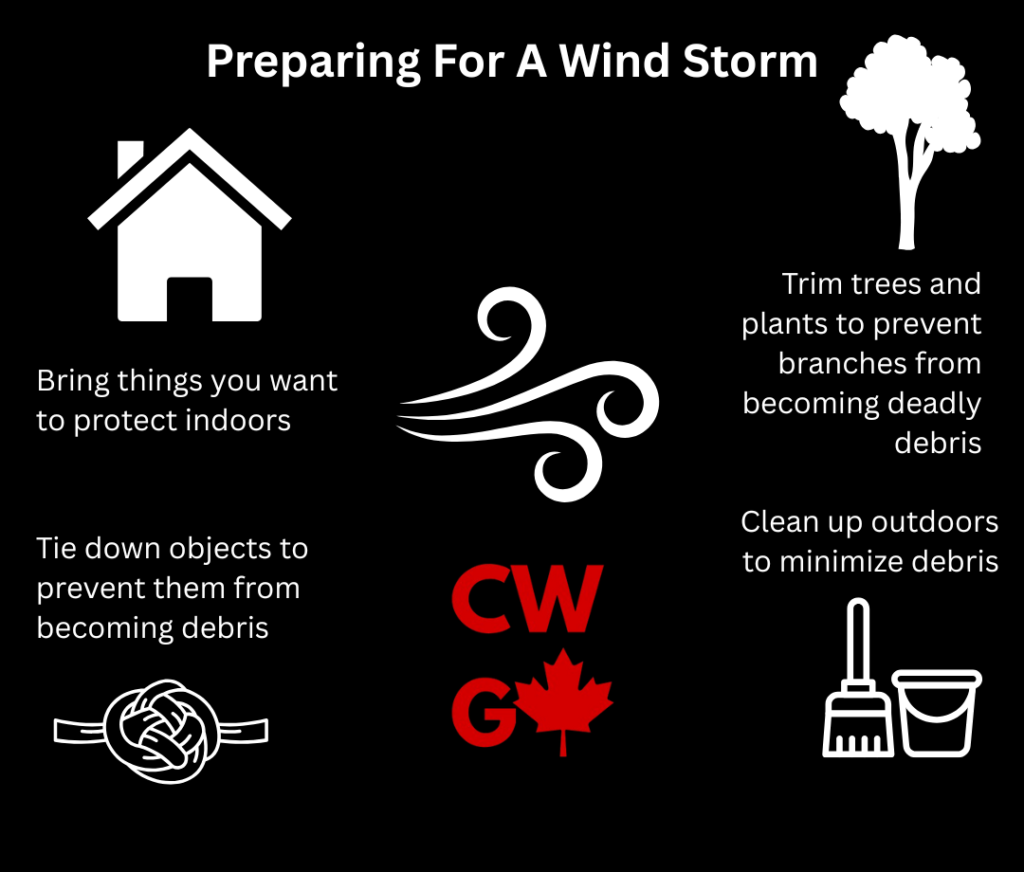
Stay indoors. Flying debris is the most common cause of injuries in windstorms, and being indoors provides you protection against this.
Tie outdoor items down before the storm. This helps prevent debris from flying around in the first place.
Clean up the outdoors. This means that there will be less debris that could potentially fly around later. Put things like gardening tools that can become lethal debris in a garage, shed or other safe indoor place.
Trim things like trees and other plants to make it so that there’s less debris that can blow around. Even if these items don’t blow off their plants, they can be blown into people or items, damaging them.
Take things you want to protect indoors. This includes things like bringing your car into your garage if needed. Keep in mind there are also other things that you can do to prepare for a windstorm, regardless of whether you live in one of the windiest cities in Canada or not. Many of these are similar to how you can prepare for a blizzard.