What Is Saturn?
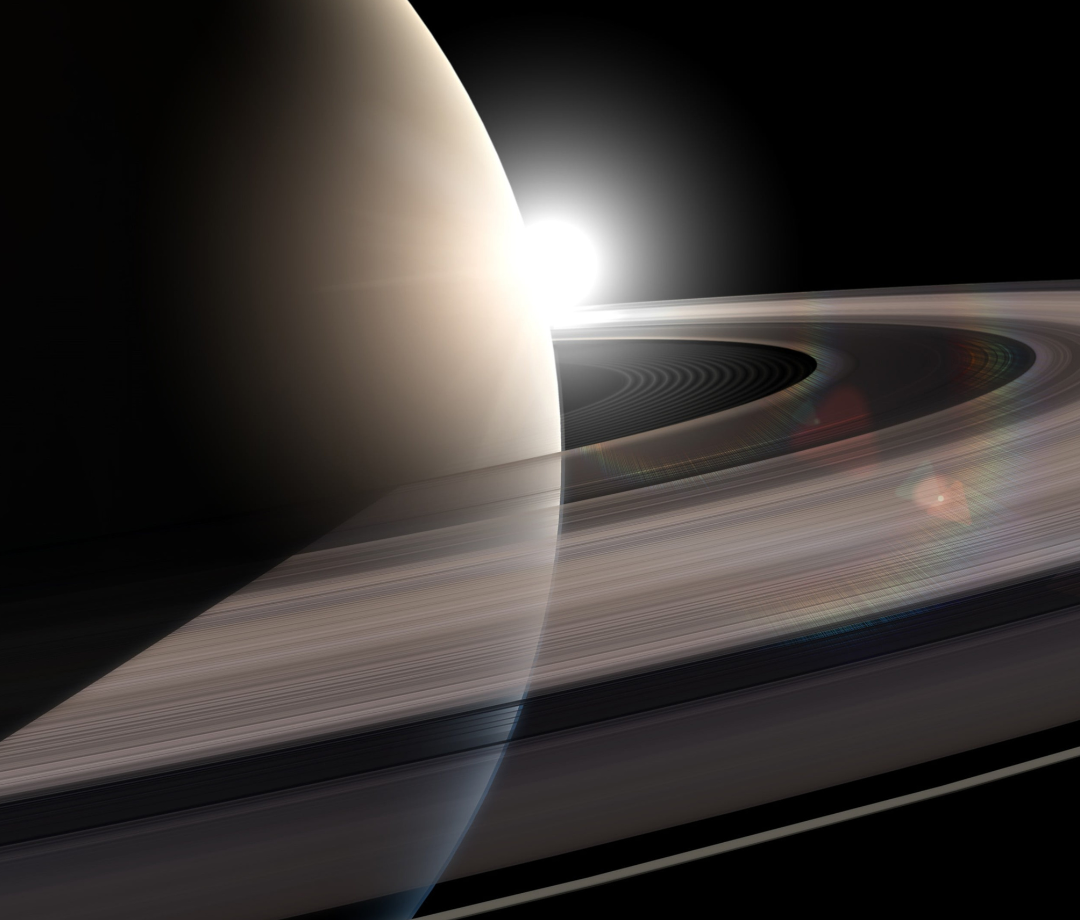
Saturn is the sixth planet from the sun. It is the second-largest planet in the solar system, with only Jupiter being larger. It is known for its beautiful rings, a large number of moons, and low density.
Saturn’s density is unique in our solar system in the fact that it is less dense than water. This means that it would be able to float in water if you were to somehow find a body of water large enough. However, despite its large size (over 80% as wide as Jupiter), Saturn is less than a third as heavy as the larger planet. This large size is also the reason it is difficult to find a body of water large enough for Saturn to float. This comparatively light weight is due to it being made up mostly of hydrogen and helium.
Saturn also has 63 named moons, the most well-known of which is Titan, a moon that is larger than Mercury. Titan is also the only moon in the solar system that has a significant atmosphere.
The origin of Saturn’s rings is not known for sure, but the most common theory is that they were caused by a moon crashing into the planet, and breaking up, with the pieces of the moon being broken up and flung into orbit around the planet. It is estimated that this ring system was created at some point in the past 100 million years. They were first observed in 1610 by Galileo Galilei, who, due to the telescope he was using, thought he was looking at three planets.
How Long Are Days And Years On Saturn?
A day on Saturn is almost 11 hours, and a year is approximately 29.5 Earth years. This is because Saturn is approximately 1434 million km (891 million miles) away from the sun, which is about 9.5 times as far as Earth is on average, and almost twice as far away from the sun as Jupiter.
What Is The Atmosphere On Saturn Like?
The atmosphere of Saturn is over 95% hydrogen, with most of the rest being helium. Acetylene, ethane, propane, phosphine, and methane are also present, but in very trace amounts.
How Warm Is Saturn?
Perhaps the better question would be “How Cold Is Saturn?”, given that the average temperature is often cited as being -140 C (-220 F) at the surface. It should be noted that, due to Saturn being a gas giant, the ‘surface’ is defined as the place on the planet where atmospheric pressure is equal to Earth’s surface. However, the core of the planet reaches 11,700 °C (21,100 °F). Most of the heat the planet receives is from this core, due to how far away the sun is.
How Windy Is Saturn?
Saturn is extremely windy, mostly due to how quickly the planet turns and its gaseous state. The highest wind speeds on the planet can reach 1800 km/h (1100 mph), mostly near the equator and in the higher portion of the atmosphere. These strongest wind speeds are usually represented by white streaks. The planet’s jet stream takes the shape of a hexagon surrounding the north pole. Two Earths could fit within the area of this hexagon.
How Rainy Is Saturn?
Saturn has a lot of rain, but not in the way you might think. It is thought that the thunderstorms on Saturn turn methane into carbon, causing it to rain diamonds on Saturn, which is perfect for a planet with such a beautiful set of rings.
Does Saturn Have Storms?
Absolutely, Saturn has storms. Most of the large white bands on the planet are hurricanes, but they are several times more powerful than the ones on Earth. It is currently unknown what causes such storms, due to Saturn being so far from the sun.
Can Saturn Support Life?
The consensus of the scientific community is that Saturn would almost certainly be unable to support life, at least as we know it. This is due to its strong gravity, cold temperature, and lack of a solid surface. While it is certainly possible that life not as we know it could exist on Saturn, the conversation about that gets strange quickly and is entirely theoretical.
Can Saturn Be Terraformed?
Almost certainly not. Saturn is too cold, has too much gravity, and lacks a surface, meaning that it would almost certainly never be terraformable.