What Is Sharknado?
Sharknado is a satirical horror science fiction film released in 2013 by Syfy. It was directed by Anthony C. Ferrante, written by Thunder Levin, and stars Tara Reid, Ian Ziering, and John Heard among others. It is the first of six movies released in a series, with the final film, The Last Sharknado, Its About Time, being released in 2018. The first film, which is the topic of this post, is known for having several tornadoes that pick sharks up out of the water and dump them into Los Angeles.
This article will dive into the possibilities of such an event occurring.
Can A Tornado Form Over Water?
For a tornado to pick up sharks, it must occur over water. Despite being less common than a tornado over land, especially considering over 70% of the earth’s surface is covered by water, a tornado can form over water. A tornado that forms over water is usually referred to as a waterspout. If the winds are 119 km/h (74 mph) or more, which is the same speed as an F1 tornado, it is classified as a tornadic waterspout, otherwise, it is called a fair-weather waterspout. If the windspeed is 181 km/h (113 mph) or faster, which is the lower end of an F2 tornado, it is referred to as a significant tornadic waterspout.
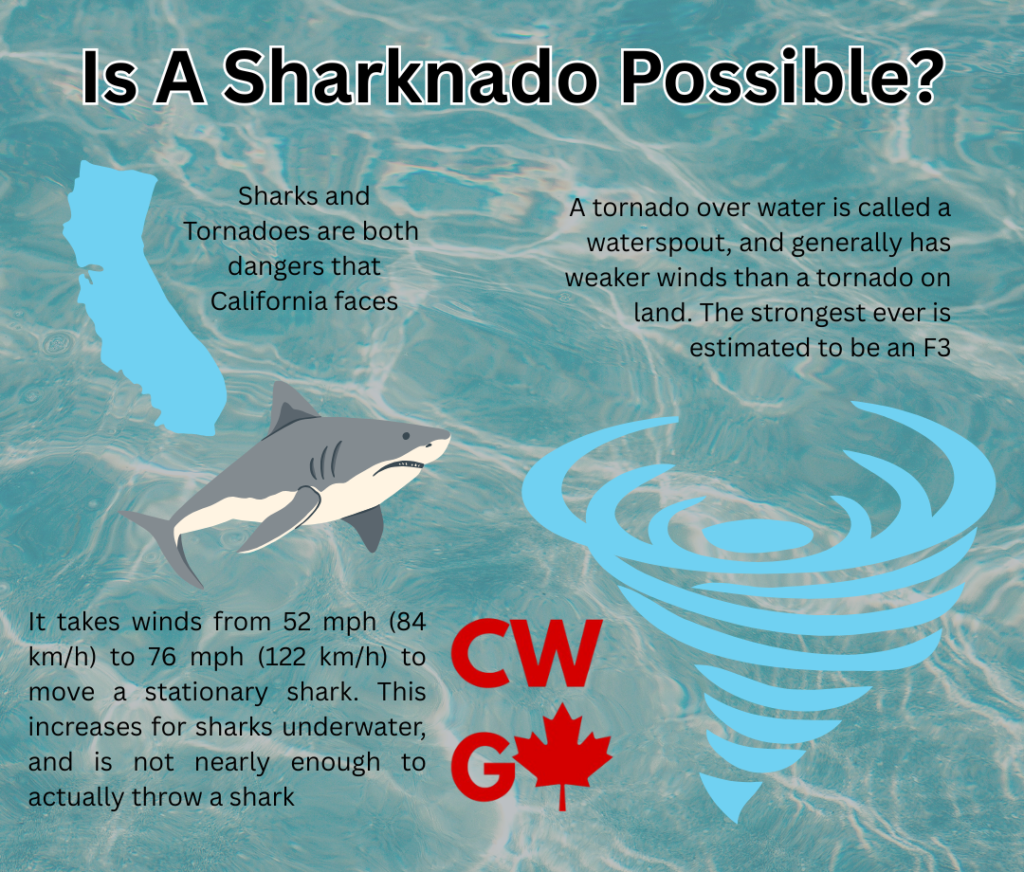
Even tornadic waterspouts are generally on the weak end of tornado stregnth. Even the Grand Harbour Of Malta Tornado, often seen as the most powerful waterspout ever, is speculated to be only of F3 strength. However, they are still dangerous and should still be avoided the same as tornadoes on land.
As it is possible for a tornado to form in water, it may still be feasible for a Sharknado to occur. However, with the most powerful known waterspout in history showing to be an F3, the possible limitation of wind speed seems to be soft capped at an F3 tornado. This limit should be noted, although it appears to be based on limited information.
Locations Of Great White Shark Habitats
Great white sharks are the most prominent species of shark featured in the movie. Great white sharks generally live in temperate waters close to the shore. They also tend to prefer that the water they swim in is between 10 C (50 F), and 20 C (68 F). They live off both the eastern and western coasts of the United States, including California. Hawaii is also surrounded by shark-infested waters. Other countries sharks live close to include India, Australia, New Zealand, Japan, South Africa, and Mexico, as well as most coastal countries in South America and Europe.
As Los Angeles is a coastal city that borders ocean waters that have the correct conditions for great white sharks to be common, this increases the feasibility of a possible tornado throwing sharks into the city.
Locations Of Tornadoes
When addressing the possibility of a tornado with sharks in it, a tornado is a needed ingredient. The most common location for tornadoes is tornado alley. Although tornado alley does not have an official designation, it commonly includes all or some of the following American states: Oklahoma, Kansas, North and South Dakota, Nebraska, Iowa, Indiana, Illinois, Arkansas, Ohio, Wisconsin, Minnesota, Missouri, Montana, Wyoming, Colorado and New Mexico, although a few others are often included. You will note that California is not included in this list. However, this does not mean that California is tornado-free.
In the 75 years from 1950-2024, there were a total of 478 total twisters recorded in the state of California. However, the majority of these were F0 or F1, with no F4 or F5 tornadoes being among them, and F3’s being very rare, accounting for less than 1% of all twisters in the state. Some of these tornadoes have hit LA before.
Since tornadoes have hit LA, this does show the viability of a possible Sharknado. It should be noted, however, as with waterspouts, the lack of F4 or F5 tornadoes once again shows, which reinforces the previously established soft limits of tornado strength in the area. However, this is once again based only on limited information, which should be noted.
How Much Wind Would Be Needed To Move A Shark?
If the movie of Sharknado is possible, the most important thing to determine is if a tornado would be capable of lifting a shark up and into the twister itself. For that, we would need to determine how strong of a wind is needed to pick up certain sharks.
Fortunately, there is a formula that can determine this, but it uses Imperial measurements. The formula is as follows:
Wind = √(195 X Weight / Surface Area)
Wind is the speed of the wind in mph.
Weight is the weight of the object being lifted in lbs.
Surface area is the surface area of the affected item in Square feet.
You take 195, multiply it by the weight of the object in pounds, and divide the result by the surface area of the object in square feet. You then calculate the square root of that object, and that is the wind speed in mph that is needed to lift the object.
Shark Size
This means that to determine the wind speed needed to lift a great white shark, you must know both the weight and surface area of the shark. The weight of a shark can easily be researched.
A male great white shark is estimated to weigh from 1150 lbs to 1700 lbs (522 kg – 771 kg).
A female great white shark is estimated to weigh from 1500 lbs to 2450 lbs (680 kg – 1100 kg).
However, for the purposes of surface area, will need to make some estimates, as we need to know the dimensions of a shark, its height, width and depth. Shark lengths are generally well known, as male great whites range from 11-13 feet (3.4 – 4m), and females are 15-16 feet (4.6 – 4.9m).
However, things begin to become complicated when you determine the “length” and “width” of a shark. Since sharks are torpedo-shaped, it is difficult to determine these, however. After some measurements of shark photos on my screen, we can estimate that a shark’s “height” and “width” are about equal, being 1/5 of its length. Not an exact science, but close enough for the purposes of getting an estimate.
Finding The Variables
For the sake of simplicity and to make our estimations easier, we will use a cylinder to stand in for the shape of a shark. Determining the surface area of a cylinder can be done with the following formula, with A referring to surface area, l referring to the length, and r referring to the radius. For those who forget the “radius” is half the length of the width of a circle, making it equal to 1/10 of the length:
A =2πrl + 2πr2
For this purpose, will we use the smallest and largest sizes mentioned earlier. The smallest great white is 11 feet long, giving it a radius of 1.1 feet (rounded).
A =2π X 1.22 X 11+ 2π X 1.12
Using the formula to find the surface area of a cylinder, gives it a surface area of 83.63 feet.
We now plug that and its weight of 1150 lbs (680 kg) into the original formula to find out how much wind it would take to move this beast in mph.
Wind = √(195 X 1150 / 83.63)
We get a result of 51.78, which rounds to 52 mph (84 km/h). This is a surprisingly weak speed, as it is within the F0 range. However, it should be noted that this is only enough to move the object when it is stationary, not lift it into the air.
However, now we repeat the process with the largest sharks.
This shark has a length of 16 feet, which according to our formula gives it a surface area of 176.93 feet. Plug the weight of 2450 lbs (1100 kg) into the formula, and we get a wind speed of 75.58 mph, rounded to 76 mph (122 km/h) just barely within F1 standards. However, once again, this is the wind speed needed to move the shark, not lift it.
Can A Tornado Lift Several Sharks?
Since tornado-force winds could move a large shark, this lends credibility to the idea of a Sharknado happening. However, you must keep in mind that this is just to move it, if it is stationary, on land, not throw it when it’s actively resisting in the water. The same formula states that it would take a 67 mph (108 km/h) wind to move an average person, and a 90 mph (145 km/h) wind to move a parked car.
Is A Sharknado Possible?
Since it generally takes an F4 tornado to throw a vehicle, and this doesn’t account for the fact that both waterspouts and tornadoes in California are not recorded as getting this powerful, getting a tornado that overcomes both these disadvantages is unlikely. Then also need to remember that the tornado would need to be even stronger to lift a shark out of the water when it is several feet below, great white sharks are solitary animals, and the path it would have to take to hit LA when being a waterspout is highly precise. As a result, we must conclude that while in theory, a Sharknado is possible, in reality, it is unlikely to ever happen.